Support
Secure Payment Methods
Book your Pakistan tour with confidence using our trusted international and regional payment options.




Walk into the heart of the Karakoram. The K2 Base Camp Trek is one of the world's great high-altitude trekking adventures, taking travelers deep into the mountains of Gilgit-Baltistan through the legendary Baltoro Glacier, Concordia and the K2 region.
K2 rises to 8,611 metres and is the second-highest mountain on Earth. Reaching its base camp does not require climbing the summit, but the journey is still a serious expedition through remote and demanding terrain. Trekkers cross rocky moraine, glacier landscapes and high mountain valleys while surrounded by some of the most dramatic peaks in the Karakoram.
The journey normally begins in Islamabad before continuing toward Skardu, the gateway to the Central Karakoram. From Skardu, the route leads toward Askole and then deeper into the mountains, eventually reaching Concordia and the K2 Base Camp area.
K2 Base Camp offers something very different from a conventional mountain holiday. There are no roads leading to the destination and no easy viewpoint from which to observe the landscape. The mountains are experienced gradually, day after day, on foot.
The route passes through a remarkable sequence of landscapes. River valleys give way to barren mountain terrain, then to the immense Baltoro Glacier and finally to the extraordinary amphitheater surrounding Concordia.
For trekkers, the destination is only part of the experience. The journey itself is what makes K2 Base Camp so memorable.
Adventure Touristik's existing K2 guide describes the route as one of the world's renowned trekking experiences and highlights the Baltoro Glacier, Concordia, Broad Peak and K2 as major features of the journey.
K2 stands at approximately 8,611 metres and is the second-highest mountain in the world. It is located in the Karakoram Range of Gilgit-Baltistan, Pakistan, near the Pakistan-China border.
The mountain is famous not only because of its height but also because of its steep and technically demanding climbing routes. For trekkers, however, the objective is not to climb K2 but to reach the base camp area and experience the extraordinary landscape surrounding the mountain.
K2 is often associated with the name Savage Mountain, reflecting the serious challenges faced by mountaineers attempting its summit. The trekking route provides a much more accessible way to experience the mountain environment without undertaking a summit expedition.
The K2 Base Camp region lies deep within the Central Karakoram, far beyond ordinary road access. The surrounding landscape contains glaciers, enormous rock walls and a concentration of high peaks rarely matched anywhere else in the world.
The region is particularly famous for the meeting of major glaciers around Concordia and the views toward K2, Broad Peak and the Gasherbrum group.
Because of its remoteness, the journey requires careful logistical planning. Food, camping equipment, porters, guides, permits, transportation and contingency days all need to be considered before departure.
Skardu is the main gateway for many trekking and mountaineering journeys into the Central Karakoram. It is the last major town where trekkers can complete preparations before heading toward the remote mountain trail.
Travelers normally use Skardu to organize final equipment, supplies, transportation and expedition logistics. It is also an opportunity to rest before the demanding trekking section begins.
For travelers arriving in Pakistan for the first time, Skardu provides a dramatic introduction to the landscape of Baltistan, with broad valleys, rugged mountains and the Indus River shaping the surrounding environment.
Explore Skardu Valley if you want to understand the gateway region before beginning your K2 adventure.
Askole is traditionally regarded as the final major settlement before the trekking route enters the remote mountain environment leading toward the Baltoro Glacier.
Reaching Askole marks an important transition. From this point onward, the journey becomes increasingly dependent on walking, camping and expedition logistics.
The route ahead passes through the Braldu Valley before gradually entering the glacier environment that defines the classic K2 Base Camp approach.
The Braldu Valley forms an important part of the approach toward the Baltoro Glacier. The landscape becomes increasingly rugged as the route moves deeper into the Karakoram.
Early trekking days introduce travelers to the rhythm of expedition life. Walking hours, changing weather, river crossings, camp routines and altitude gradually replace the conveniences of ordinary travel.
This gradual transition is important for acclimatization and also gives trekkers time to adjust physically and mentally to the environment.
The Baltoro Glacier is one of the defining features of the K2 Base Camp Trek. It stretches deep into the Karakoram and provides the main trekking corridor toward Concordia and the K2 region.
Walking on the Baltoro is very different from walking on a normal mountain trail. Large sections of the glacier are covered by rocks and moraine, creating uneven terrain that requires constant attention.
The surrounding scenery becomes increasingly spectacular as trekkers move farther into the glacier system. Massive peaks rise from both sides of the route, while the glacier stretches ahead toward the heart of the Karakoram.
The Trango Towers are among the most recognizable rock formations encountered on the Baltoro route. Their enormous granite walls rise dramatically above the surrounding glacier landscape.
They are particularly famous among climbers, but trekkers can experience their scale from the trail without attempting any technical climbing.
The towers are a reminder that the K2 Base Camp route is not simply about one mountain. The entire Central Karakoram contains an extraordinary collection of peaks and rock formations.
Urdukas is an important point along the Baltoro route and is known for its elevated position and spectacular views over the surrounding glacier and mountains.
As the trek continues beyond Urdukas, vegetation becomes increasingly limited and the landscape takes on a distinctly high-altitude character.
At this stage, trekkers are increasingly surrounded by rock, ice and enormous mountain walls. The feeling of remoteness becomes stronger with every day.
Concordia is one of the defining destinations of the K2 Base Camp Trek. It sits near the meeting of major glaciers and is surrounded by an extraordinary concentration of high peaks.
On clear days, the wider Concordia panorama can include views toward K2, Broad Peak, Gasherbrum I, Gasherbrum II and numerous other major Karakoram peaks.
K2 naturally attracts the most attention, but Concordia is remarkable because of the entire mountain amphitheater surrounding it.
For many trekkers, reaching Concordia is one of the emotional highlights of the expedition.
Broad Peak rises to more than 8,000 metres and is another major mountain of the K2 region. The route toward K2 Base Camp provides opportunities to experience the landscape around Broad Peak and the upper Godwin-Austen Glacier.
Broad Peak adds another dimension to the journey because trekkers are not simply approaching one famous summit. They are moving through a landscape containing several of the world's highest mountains.
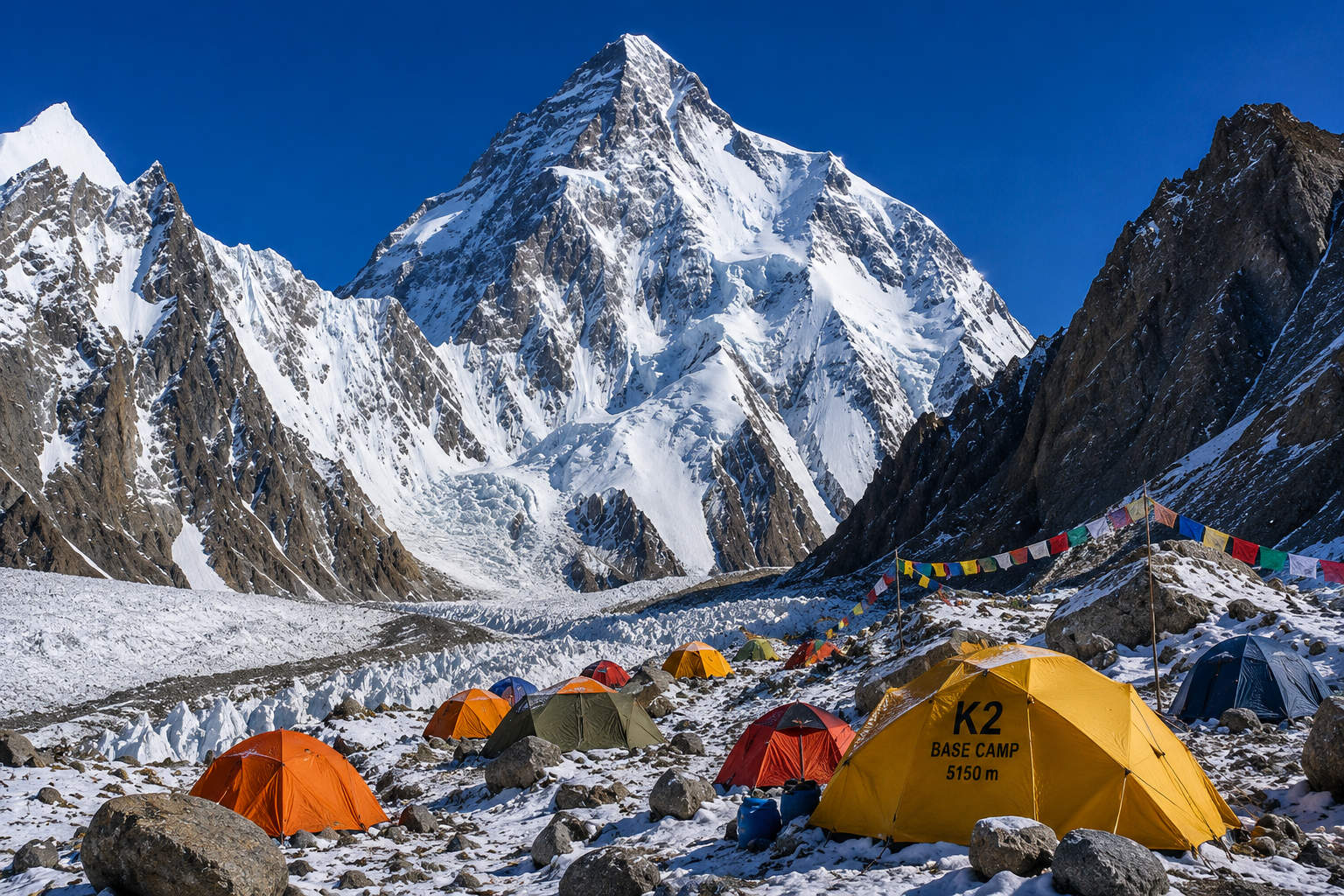
Reaching K2 Base Camp is the defining moment of the trek for many travelers. After days of walking through valleys, glaciers and high mountain terrain, K2 finally dominates the landscape.
The route toward Base Camp follows the Godwin-Austen Glacier and approaches the K2 region from the Concordia side.
The exact experience at Base Camp depends on the season and expedition activity. K2 Base Camp itself can change considerably between climbing seasons and quieter periods.
Trekkers should remember that reaching Base Camp is an expedition achievement in its own right. The goal is to experience the mountain safely, not to imitate the technical climbing objectives of a K2 summit expedition.
After reaching the K2 region, the standard trekking route returns through the Baltoro corridor toward Askole.
The return journey can feel surprisingly different even though the landscape is familiar. Looking back toward the mountains from a different direction often reveals features that were not obvious during the approach.
The descent also gives the body a gradual break from the highest elevations before the journey eventually returns to the lower valleys and road system.
The classic route follows a progression from Islamabad and Skardu into the remote Central Karakoram:
Exact camps and daily distances vary according to the expedition operator, weather, trail conditions and acclimatization requirements.
A 20-day program provides a useful framework for combining travel, acclimatization, trekking and contingency time. Actual schedules may change because of weather, road conditions, flight operations and mountain conditions.
For a serious high-altitude expedition, contingency time is important. A printed itinerary should be treated as a framework rather than a guarantee that every movement will occur exactly on schedule.
The K2 Base Camp Trek is a demanding high-altitude trekking experience. Adventure Touristik's existing K2 guide describes the route as moderately challenging while also emphasizing the effects of altitude, remote conditions and difficult terrain.
In practical terms, difficulty depends on much more than distance. Trekkers must deal with consecutive walking days, rough moraine, glacier terrain, high altitude, changing weather and limited facilities.
The route does not require participants to climb K2, but it should not be confused with an ordinary hiking holiday.
Altitude is one of the most important factors on the K2 Base Camp Trek. The route gradually climbs from the lower valleys toward Concordia and the K2 region, where conditions become significantly more demanding.
K2 Base Camp is commonly described at around 5,150 metres, although exact figures can vary slightly according to mapping references and the location used for the measurement.
Acclimatization should be built into the itinerary. Trekkers should ascend gradually, maintain hydration and communicate honestly with their guide about symptoms.
Headache, nausea, unusual fatigue, dizziness or worsening shortness of breath should never be ignored at altitude.
The main trekking season for K2 Base Camp is generally during the summer months, particularly from June through August. September can also be possible depending on conditions.
Adventure Touristik's existing K2 guide identifies June to August as the most favorable period, when conditions are generally more suitable for trekking and mountain visibility.
Winter is not suitable for a standard K2 Base Camp trekking program because extreme cold, snow and difficult access can make the route dangerous or inaccessible.
Weather in the Karakoram can change quickly. Clear skies can give way to cloud, snow or strong wind, and conditions at high elevations can be very different from those in Skardu.
Trekkers should be prepared for cold nights even during summer and carry suitable layers and weather protection.
Weather can also affect flights between Islamabad and Skardu and road transportation into the mountains. Building flexibility into the overall itinerary is therefore essential.
Good physical preparation makes the K2 Base Camp Trek considerably more manageable. Training should begin well before departure and should focus on endurance rather than short bursts of fitness.
Long hikes, uphill walking, stair training, cycling and strength work can all help prepare the body for consecutive days in the mountains.
It is particularly useful to train on back-to-back days because the challenge is not simply completing one long hike. Trekkers need to recover and walk again the following morning.
Mountain equipment should be selected according to the season, route and operator's support system.
Exact technical equipment requirements depend on the itinerary. Standard K2 Base Camp trekking should not be confused with the more technical Gondogoro La crossing, which can require additional mountaineering equipment.
Expedition meals are designed to provide enough energy for long trekking days while remaining practical in remote mountain camps.
Meals may include rice, pasta, lentils, vegetables, soups, meat, bread, eggs and traditional Pakistani dishes depending on the expedition kitchen and available supplies.
Hydration is especially important at altitude. Trekkers should follow their guide and expedition team's procedures for treating or obtaining safe drinking water.
The K2 Base Camp Trek combines hotel accommodation in major towns with camping once the trekking section begins.
Mountain camps are considerably simpler than hotels. Travelers should expect tents, shared dining arrangements and basic facilities rather than conventional accommodation.
The simplicity is part of the expedition experience. After several days in the mountains, even a basic hot drink or warm meal can become a memorable part of the journey.
The K2 region is a regulated trekking and mountaineering area. Foreign trekkers may require permits, registrations, route documentation and other government approvals depending on the current regulations.
Requirements, fees and procedures can change. Adventure Touristik's existing K2 guide notes that trekkers may require a special K2 trekking permit and recommends arranging the journey through a registered trekking company.
Before departure, confirm exactly which permits, government charges and services are included in your trekking package.
Comprehensive travel insurance is strongly recommended for a K2 Base Camp expedition. The policy should be appropriate for high-altitude trekking and the emergency situations that can occur in remote mountain regions.
Read the policy carefully rather than assuming that standard travel insurance automatically covers high-altitude trekking.
Emergency evacuation provisions are particularly important because medical facilities are limited once the trek enters the remote Karakoram.
The K2 region is an exceptionally remote and sensitive environment. Responsible trekking helps protect the mountains and supports the communities and workers who make expeditions possible.
Experienced trekkers sometimes combine the classic K2 Base Camp route with the Gondogoro La crossing to create a more demanding Karakoram traverse.
The two routes share major sections of the journey, including the Baltoro Glacier, Concordia and the K2 region. The difference comes after reaching the upper Baltoro, where the Gondogoro route continues toward Ali Camp and crosses Gondogoro La before descending toward Hushe Valley.
This option is considerably more demanding than the standard K2 Base Camp return route and may involve steep snow and ice, fixed ropes and additional technical equipment depending on conditions.
Adventure Touristik's current Gondogoro La guide specifically distinguishes the route from the standard K2 Base Camp trek and describes it as a more demanding Karakoram traverse.
Read the Gondogoro La Trek guide if you are considering the extended traverse.
Fairy Meadows and K2 Base Camp offer very different mountain experiences. Fairy Meadows provides a comparatively accessible alpine landscape with views toward Nanga Parbat, while K2 Base Camp is a much longer expedition deep into the Central Karakoram.
Travelers with sufficient time can combine both destinations in a wider northern Pakistan itinerary, experiencing two of the country's most famous mountain landscapes.
Explore Fairy Meadows for Nanga Parbat views, hiking and alpine scenery.
Hunza can also be combined with a K2 Base Camp expedition, although the trekking program requires substantial time and should not be rushed.
Hunza provides a valuable cultural contrast to the remote glacier environment of the K2 region, with historic forts, villages, orchards, mountain views and the Karakoram Highway.
Explore Hunza Valley when planning a wider northern Pakistan journey.
K2 Base Camp is located in the Central Karakoram of Gilgit-Baltistan, Pakistan, in the K2 region beyond Concordia and along the Godwin-Austen Glacier.
K2 Base Camp is commonly given at approximately 5,150 metres above sea level. Exact figures can vary slightly depending on the measurement reference and specific location used.
The trekking program varies by operator and route design. Adventure Touristik's existing guide describes the core trek as commonly taking around 12 to 14 days, while a complete Pakistan expedition with Islamabad, Skardu, acclimatization and contingency time can be considerably longer.
A 20-day program is a practical framework when additional travel, acclimatization and contingency time are included.
Yes. It is a demanding high-altitude trek involving long walking days, rough terrain, glacier travel, altitude and remote conditions. Previous trekking experience and good physical preparation are strongly recommended.
June through August is generally the main trekking season, with September sometimes possible depending on conditions. Adventure Touristik's K2 guide identifies June to August as the most favorable period.
Yes. K2 dominates the landscape around the Base Camp region, although visibility depends on weather and cloud conditions.
Yes. The classic K2 Base Camp route follows the Baltoro Glacier for a significant portion of the approach toward Concordia and the K2 region.
The trek is not an ideal first mountain experience. While it does not require climbing K2, the altitude, length, rough terrain and remote conditions make previous trekking experience and strong preparation highly advisable.
Yes, experienced trekkers can consider the Gondogoro La route after reaching the K2 region. However, the crossing is substantially more demanding and can involve steep snow and ice, fixed ropes and technical equipment depending on conditions.
Comprehensive travel insurance is strongly recommended. Make sure the policy specifically covers high-altitude trekking at the elevations included in your itinerary and provides appropriate emergency and evacuation coverage.
K2 Base Camp is one of the greatest trekking experiences in northern Pakistan, but the wider Karakoram offers many other destinations and routes for travelers interested in mountains, culture and adventure.
The K2 Base Camp Trek is more than a journey to one famous mountain. It is a complete expedition through the heart of the Karakoram, combining the Baltoro Glacier, Concordia, Broad Peak, enormous granite towers and the unforgettable presence of K2.
Adventure Touristik can help organize K2 Base Camp trekking programs, expedition logistics and wider Pakistan itineraries according to your experience, travel dates and interests.
For experienced trekkers considering an even greater challenge, the K2 route can also be combined with the Gondogoro La traverse when conditions and experience are appropriate.
Explore Pakistan Tours and start planning your K2 Base Camp adventure with Adventure Touristik.
FEATURED ARTICLE
Journey deep into the Central Karakoram through Askole, the Baltoro Glacier and Concordia before reaching the K2 Base Camp region beneath the world's second-highest mountain.
FEATURED ARTICLE
Combine the legendary K2 Base Camp route with the demanding Gondogoro La crossing for a full Karakoram traverse from the Baltoro region toward Hushe Valley. This option is intended for experienced high-altitude trekkers.
FEATURED ARTICLE
Begin your K2 adventure in Skardu, the gateway to the Central Karakoram, before continuing toward Askole, Baltoro Glacier, Concordia and K2 Base Camp.
FEATURED ARTICLE
Combine a demanding K2 trekking expedition with the cultural landscapes of Hunza Valley, including historic forts, mountain villages and spectacular Karakoram scenery.
FEATURED ARTICLE
Experience two of northern Pakistan's legendary mountain landscapes by combining the remote K2 Base Camp expedition with the alpine meadows and Nanga Parbat views of Fairy Meadows.
受信トレイへの思いやりのある考え
Book your Pakistan tour with confidence using our trusted international and regional payment options.
Follow us @AdvTouristik
Copyright © 2026 Adventure Touristik Pvt Ltd®. All Rights Reserved.

